
What NAB New York Revealed About the Future of Broadcast Monitoring
For 2110 Solutions, NAB Show New York 2026 was about more than technology. It was about industry recognition, unexpected conversations and the growing importance of visibility in increasingly dynamic broadcast environments.
Smaller and more intimate than its Las Vegas counterpart, NAB New York offers something particularly valuable: meaningful conversations with the people who design, integrate and operate broadcast infrastructures. Conversations that often start with a technical question and end somewhere considerably more interesting.
This year, our team of Joe LoGrasso, Bridge Technologies Chairman Simen K. Frostad and our newest colleague, Bil Apker, who recently joined 2110 Solutions to lead Customer Relations and Business Development, certainly had plenty of those.
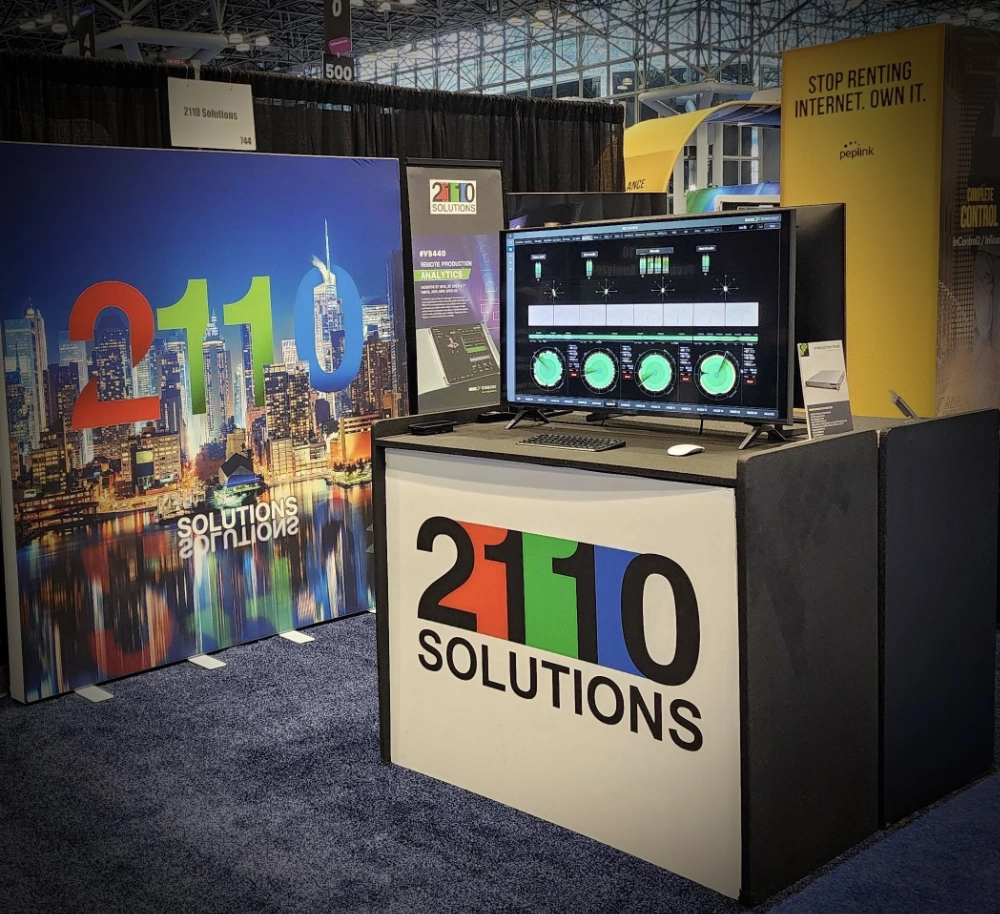
We welcomed familiar faces from broadcasting, media organizations and universities, alongside new customers, ProAV professionals and European systems integrators. But somewhere between demonstrations and discussions about emerging architectures, Joe noticed something different.
“For the first time, I wasn’t spending my time explaining who 2110 Solutions was,” said Joe LoGrasso, CEO of 2110 Solutions.
The pleasure of being recognized
For a company dedicated to bringing specialist broadcast technology to North America, brand recognition is an important milestone.
Previously, conversations often began by introducing 2110 Solutions as the North American business partner of Oslo-based Bridge Technologies, developer of the VB440 monitoring and analytics solution for SMPTE ST 2110 networks.
This year, visitors already knew. They understood the technology and arrived with specific questions about integrating its capabilities into their workflows.
Moving from explaining what a technology does to discussing what customers can achieve with it represents a different level of market maturity. For Joe, after years of building relationships and supporting Bridge Technologies across North America, it was particularly satisfying.
When integration goes beyond integration
One fascinating conversation concerned a US broadcaster that had used the VB440’s APIs to integrate monitoring data with routers, controllers and other systems, bringing everything together through a unified interface.
The significance lies in the VB440’s open, HTML5-based architecture and API accessibility. Rather than being restricted to Bridge’s interface, customers and systems integrators can incorporate its monitoring and analytics capabilities into customized operational environments, combining information from multiple vendors.
For operators, this means fewer separate applications, more contextual information and faster decisions. For integrators, it creates opportunities to develop solutions tailored to individual requirements.
Hearing directly from those implementing such solutions reveals how customers are extending the technology’s value beyond its original applications.
Beyond broadcast: new conversations, new opportunities
Interest in applications beyond traditional broadcast production was another notable development.
Bridge Technologies’ IPMX support for the VB440 resonated strongly with visitors. Having supported IPMX-related workflows throughout the standard’s development, including earlier TR-07 implementations and full TR-10 compliance, the VB440 can also serve as an independent reference tool for validating interoperability across complete systems.
Meanwhile, the award-winning TS Playout functionality attracted renewed interest in the distribution probes. By combining transport stream playout with monitoring, analysis, recording and troubleshooting, these probes demonstrate how specialist tools can deliver greater operational versatility.
Both developments reflect a recurring customer priority: powerful monitoring solutions that are increasingly interconnected, adaptable and easier to integrate.
The Dynamic Media Facility
Perhaps the most forward-looking conversations involved Simen K. Frostad and the Dynamic Media Facility (DMF) concept.
Building on SMPTE ST 2110, DMF advances broadcast infrastructure towards flexible, software-defined production environments. Supported by the EBU’s DMF Reference Architecture and Media eXchange Layer (MXL), it promotes interoperable media functions that can be deployed and adapted according to operational requirements rather than tied to fixed hardware.
The benefits in scalability, resource utilization and flexibility are considerable. But increasingly dynamic infrastructures demand equally comprehensive operational visibility.
Bil Apker captured this challenge particularly well: “Dynamic Media Facilities may represent the most significant evolution in broadcast infrastructure since ST 2110. As manufacturers move toward dynamically allocated resources, we gain the flexibility to build for what we need, rather than what we might need. But with that flexibility comes a new challenge: visibility. As resources, signal paths, and workflows become increasingly dynamic, understanding what’s happening throughout the media environment in real time becomes critical.” He continued: “That’s where the VB440 comes in, providing the visibility and analysis necessary to maintain confidence in a resource-driven media workflow.”
Indeed, software-defined infrastructures intensify rather than diminish the importance of monitoring. Accurate, real-time insight into signal integrity, PTP timing, packet behaviour and audio-video synchronization remains essential. The VB440’s monitoring capabilities, intuitive visualization and open APIs make it particularly relevant to these evolving environments, enabling reliable data to become part of broader operational systems.
Interestingly, the US broadcaster’s integration discussed earlier already demonstrates this principle: combining monitoring and control within customized interfaces, an approach increasingly relevant to DMF-oriented infrastructures.
The value of conversations
Trade show success is often measured in visitor numbers, demonstrations and business opportunities. But some outcomes are less tangible.
For Joe, NAB New York confirmed the growing recognition of 2110 Solutions and Bridge Technologies. For Bil, it strengthened customer relationships and provided insight into emerging requirements. And for Simen, discussions about Dynamic Media Facilities reaffirmed a vision of the industry’s technological evolution that he has championed for years.
The diversity of visitors made these exchanges particularly rewarding. Hearing directly how an integrator has extended a technology’s capabilities, or discussing future architectures with those developing them, provides insights that no presentation can fully replicate.
These are the conversations that make exhibitions worthwhile. And sometimes, the most interesting thing you discover is precisely what you didn’t know you were looking for.