

Hardware Probe
The VB120 broadcast probe offers a cost-effective and powerful monitoring solution, covering the most commonly available signal formats. In particular, the VB120 is capable of monitoring IP unicasts and multicasts, OTT/ABR streams as well as a whole range of RF formats. The VB120 probe hardware is custom designed and built to telco-grade standards for maximum reliability and minimum maintenance. Each VB120 blade consumes less than 12W of power. This substantially reduces power consumption and air conditioning needs in installations. The VB120 can be paired with a full set of interface blades to cover signal formats such as DVB-T/T2, DVB-S/S2, DVB-C/C2, QAM-B, 8VSB, ISDB-T and ASI. The ability to continuously measure all your media services makes the VB120 invaluable for confidence monitoring, thus facilitating a more rapid network expansion. In addition, the VB120 can perform deep analysis of the broadcast signal, reducing the need to travel to remote locations when changes in the system are made or to find the reason behind alarms.
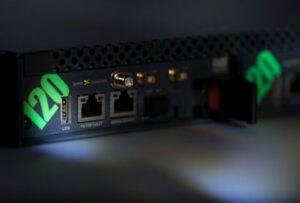
The VB120 features a fully-fledged ETSI TR 101 290 monitoring engine used to monitor enabled inputs, one monitoring engine per input working in parallel. The basic VB120 monitors DVB, ASI and IP monitoring enabled through the IP Monitoring and Analysis option. Additional RF inputs may be included by adding demodulator blades to the system.
Each Bridge Technologies ETSI TR 101 290 engine performs Priority 1, 2 and 3 measurements in addition to monitoring vital CA parameters, CA monitoring being of vital importance as CAS errors may lead to equally severe impairments as ETSI TR 101 290 Priority 1 errors. The monitoring engine may also be configured to check signal scrambling. PSI/SI and PSIP tables are analysed and presented as table summary and hex dump, the latter enabling analysis of proprietary descriptors.
Bit rates are measured at TS, service and PID level, and the ETSI TR 101 290 engine also monitors RF parameters for optional demodulator inputs. Fully configurable round-robin functionality enables sequential monitoring of several transport streams per monitoring engine. More details can be found in the ETR290 pages.
It is possible to monitor OTT/ABR streams at master play-out or at the CDN origin server in all common streaming formats using the OTT option. Streaming formats supported currently include Microsoft Smoothstream™, Apple HLS™, Adobe HDS™, MPEG-DASH and basic RTMP.
The innovative RDP technology (Return Data Path) that comes as standard on the VB120 enables easy re-routing of remote signals from regional locations into a central location for decryption and advanced signal analysis. RDP reduces the need for truck rolls and the on-site visits that would otherwise be necessary by skilled and expensive engineers. The VB120 recording functionality allows alarm triggered or manually initiated recordings from any enabled input.
The VB120 has been designed to support all modern encapsulation standards including ISO/IEC13818-1 Transport Streams and MFRTP. The VB120 continuously measures signal loss, packet loss and packet jitter. These vital parameters are presented through Bridge Technologies’ own patented MediaWindow™ technology. MediaWindow™ allows for current and historical data to be displayed in an intuitive and visual way for easy understanding of the media flows in an IP network.
Alarm handling is one of the main tasks of the VB120 Broadcast Probe, and all measurements are checked against user-defined thresholds for alarm generation. A sophisticated threshold template system gives the user full alarm handling control at probe, TS, service and PID level, ensuring that only relevant alarms are displayed
Management and control for the basic VB120 is available through a separate 10/100/1000-T Ethernet interface; the IP-enabled VB120 may alternatively be managed in-band through the 10/100/1000-T video interface or through the SFP video interface. Standalone access is achieved through the use of any standard modern web browser, avoiding the need for a dedicated client application.
With SNMP trapping and the comprehensive Eii™ (External Integration Interface) XML export the VB120 Broadcast Probe is easily integrated into existing NMS systems either directly or through the optional VBC Controller Server (VBC).
Related Bridge Technologies Products

Bridge Technologies Widglets
WidgletsTM are HTML monitors for the VB440 monitoring and analysis tool. It allows the probes to become truly multifunctional for monitoring IP Networks and extending its usefulness well beyond just test and measurement.

Nomad and Nomad Pro
Bridgetech’s NOMAD provides mobile validation and monitoring in hybrid IP multicast, OTT and RF networks. NOMAD and NOMAD-PRO, cover all the monitoring needs encountered in hybrid IP multicast, OTT and RF networks.

VB220
The VB220 Probe is the perfect choice in any network where digital video is carried across an IP-based infrastructure. Built specifically to high-end industry needs, this network service tool is ideal for both pure IP networks and hybrid networks with IP transport cores such as in digital cable and terrestrial networks. Built to telco-grade standards for maximum reliability and minimum maintenance and can be paired with a full set of interface blades to cover signal formats such as DVB-T/T2, DVB-S/S2, DVB-C/C2, QAM-B, 8VSB and ASI.

VB330
With dual 10G Ethernet connectivity and a massive multiprocessor architecture the VB330 can deliver monitoring and analytics of thousands of streams and a multitude of technologies in real-time and in parallel. The VB330 is very much a multi use tool to monitor network performance involving signal formats and areas as diverse as video IP multicast, video OTT/ABR streaming, voice trunks, video-on-demand unicast, Ethernet packet micro bursts, PCAP recording and general traffic protocol inspection.

VB440
The VB440 IP probe provides a breakthrough for the monitoring and analysis of high-bitrate broadcast media traffic as defined in ST2110 and ST2022-6 for core broadcasting networks, production studios, master control centres and outside broadcast vehicles and venues. With support for interface speeds from 10, 25, 40, 50 and up to 100 Gigabit on dual interfaces, even the largest of media networks can be accommodated with analysis of SD, HD, HD HDR, 4K, 4K HDR and 8K.